Friday, 30 July 2021

Olympic Provocation

LI.to compare there and now with the Olympic places.

The DLO showing above is about the amount of money that was spent to build and help with the olympics. My reading group wrote some no and yes ideas as example yes they should spent this money to make their families proud, also with no because people could use the money with vaccines. We also found a photo of then and now happening every four years.

Acids and Bases | Topic 8

Today for tech we have been learning about what products are acids and what are bases.

First we learnt about the differences between acid and bases. Using this information we created a table and experimented on 11 different types of chemicals, which are toilet cleaner, distilled water, apple juice, detergent, milk, window cleaner, orange juice, lemon juice, baking soda, tea, and vinegar. To find out if the product was acid or base we used pH stripes.

These items were put into a well plate. To help us find out which product is an acid or base we used blue and red litmus paper. The red litmus paper will turn blue if it’s base but if it is acid it will stay the same colour, the blue litmus paper will do the opposite. We used a pH chart to find out the colour level.

I enjoyed learning about different products that produce acids or bases.

Thursday, 29 July 2021

Thinking Grid | Water Safety

LI.to learn how and why we need to stay safe in and around water. 


Today we have done an activity about water safety. We are doing this water safety at PBS because we are surrounded by water and if we’re in a situation where we need to stay a float or swim we can use it. In this activity we needed to respond to six questions that showed our knowledge of water safety. Then we wrote a collaborative paragraph using our responses on our thinking grid. 


I enjoyed this activity because it helped me show my knowledge of water safety.

.

Olympics Maths Challenge 1

LI. to use the most efficient strategy to find the answers.

LI. to use LS2 Maths Talk to discuss strategies.


The most efficient strategy I used to solve this challenge was addition and division. Addition strategy was used to find out how many meters Micheal swam for all of his different events, and the division strategy was used to find out how many strokes he did if he took 2 meters in each stroke. 

Steps:

For or the freestyle relay (4x100m), we didn't multiply it, the 4 is the amount of people that did it so Michael was 1 of 4 so it is 100 same for the medley relay and the second freestyle relay. 


The maths:


400

100

200

200

200

100

+100

-----------

1500


Then, I divide 1500 by 2 because for every stroke Michael takes it is 2 meters. 


1500 divided by 2 = 750


So 750 is the amount of strokes to take Michael over to the end of the pool


I enjoyed doing this activity because it helped me improve my division skill. 

Wednesday, 28 July 2021

Olympics Maths Challenge 2

LI. to use the most efficient strategy to find the answers.

LI. to use LS2 Maths Talk to discuss strategies.
For this task we used the most efficient strategy to solve maths questions. The most efficient strategy that was used for this challenge was addition and subtraction. These strategies were used when we needed to find out the answer of how much the Gold medalist scored over Nastia, and used to find our how much points did Nastia scored than the Bronze medalist.

Steps:

For the first question the Gold medal winners score was 16.726 because Nastia scored 16.725 and the gold medalist scored 0.001 more than Nastia. So we added 0.001 and 16.725, that gave us the score of the gold medalists.

To see if our answers were correct we subtracted 16.726 to 0.001 which equalled to 16.725, and added 1.75 to 14.975 which equalled to 16.726.

For the second question Nastia scored over 1.750 than the Bronze medalist because we subtracted the 14.975 (third place winner score) to 16.725 (second place winner score) which equal to 1.750.

To see if the answer was correct, we added 1.750 to 14.975 that equals 16.725.

I enjoyed doing this challenge because it helped me improve my decimal challenge. 

Super Fingers Competetion

LI.to recall our timestable quickly.


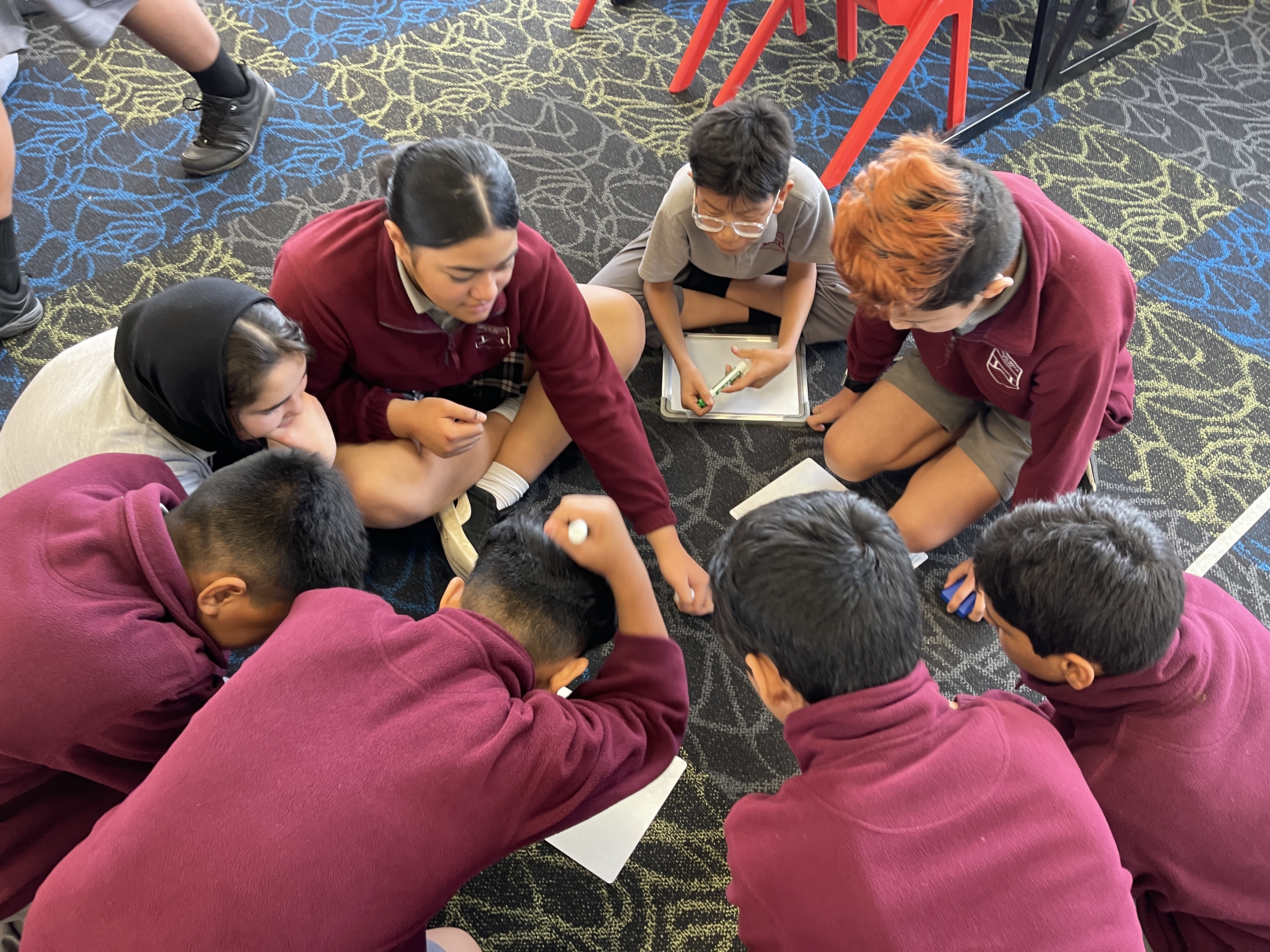
Today for maths we have recalled our multiplication knowledge by playing a game called Super Fingers. This is a game to see how well and how fast you can answer questions, by using dice.

The instructions of this game is that we need to write a phrase on a white board or piece of paper. Then you will need to roll 2 dice which we will multiply by, and the first person to call out the answer will take one of the letters out. The first person to have all of the letters rubbed out will win the game

The process we did it in was similar to a netball game, draw, quarter finals, semi finals, and lastly finals. To run this competition smoothly we created a bracket which showed who will versus who. Our bracket was now even so later in the game we did a wild card who were Vayan and Micah.

In pairs we challenged each other to see who was faster at answering the questions. The winner would go against the winner from another person. Whoever wins goes up against another winner, and it will keep going until there are two people left, which would be the finals.

The two people facing each other in the finals were Afatia and Chris.

I enjoyed doing this activity because it helped me recall my multiplication facts, and answer it more quickly.


Friday, 9 July 2021

Osmosis and transpiration


Today for science we have been learning about osmosis and transpiration. During this task we used a celery to see the tiny tubes inside which will absorb the water to the leaves.

We first learnt about photosynthesis which is the method on how a plant grows and how they become food. The leaves are the part of a plant where photosynthesis happens. Tiny Cells and special cells help to distribute food in different parts of a plant. This method is called phalon and xylem.

Next we did the experiment which was using a conical flask, water, food colouring, water, bag, and a twist tie. Using these ingredients can help us observe the movement of the water from the roots to the leaves through xylem.

Lastly, we cut open the stems of the celery to see the coloured water going through the stalk. This shows how much water has been absorbed.

I found this session interesting because I learnt the procedure on how a plant absorbs water which goes through the cells.